



When Stress Meets the Gut: How PTSD Shapes IBS Symptoms Through the Brain–Gut Axis
Understanding Impacts of Stress and Trauma on IBS
Stress, unfortunately, is an inevitable part of life and is a physiological adaptive response to a perceived or physical threat. Stress can be acute or chronic and ranges from daily hassles (e.g., receiving a traffic ticket) to major life events (e.g., death of a spouse). Major life events are significant disruptions or life adjustments (e.g., death of a spouse) that require substantial psychological and behavioral adaptation.
While acute (short-lived) stress is unlikely to cause lasting harm, chronic stress (persisting over long periods) places continuous strain on physiological systems, increasing the risk of disease, immune dysregulation, and health-damaging behaviors. Trauma is defined as the exposure to stressful events that involve death, serious injury, or sexual violence, which can lead to Post-Traumatic Stress Disorder (PTSD), a mental health condition resulting from exposure to traumatic events that creates intense feelings of fear, helplessness, or horror.
While acute (short-lived) stress is unlikely to cause lasting harm, chronic stress (persisting over long periods) places continuous strain on physiological systems, increasing the risk of disease, immune dysregulation, and health-damaging behaviors. Trauma is defined as the exposure to stressful events that involve death, serious injury, or sexual violence, which can lead to Post-Traumatic Stress Disorder (PTSD), a mental health condition resulting from exposure to traumatic events that creates intense feelings of fear, helplessness, or horror.
Common Manifestations: Bloating, Cramping, and Stress-Induced Flare-ups
For individuals with irritable bowel syndrome (IBS), exposure to chronic stress or psychological trauma can worsen symptoms and disrupt the gastrointestinal system through the brain-gut axis. Research studies indicate a significant prevalence of childhood traumas (e.g., neglect and emotional abuse) among IBS patients. Research indicates that early childhood traumatic experiences and negative life events during adulthood are associated with a higher prevalence of IBS, greater symptom severity, and reduced quality of life.
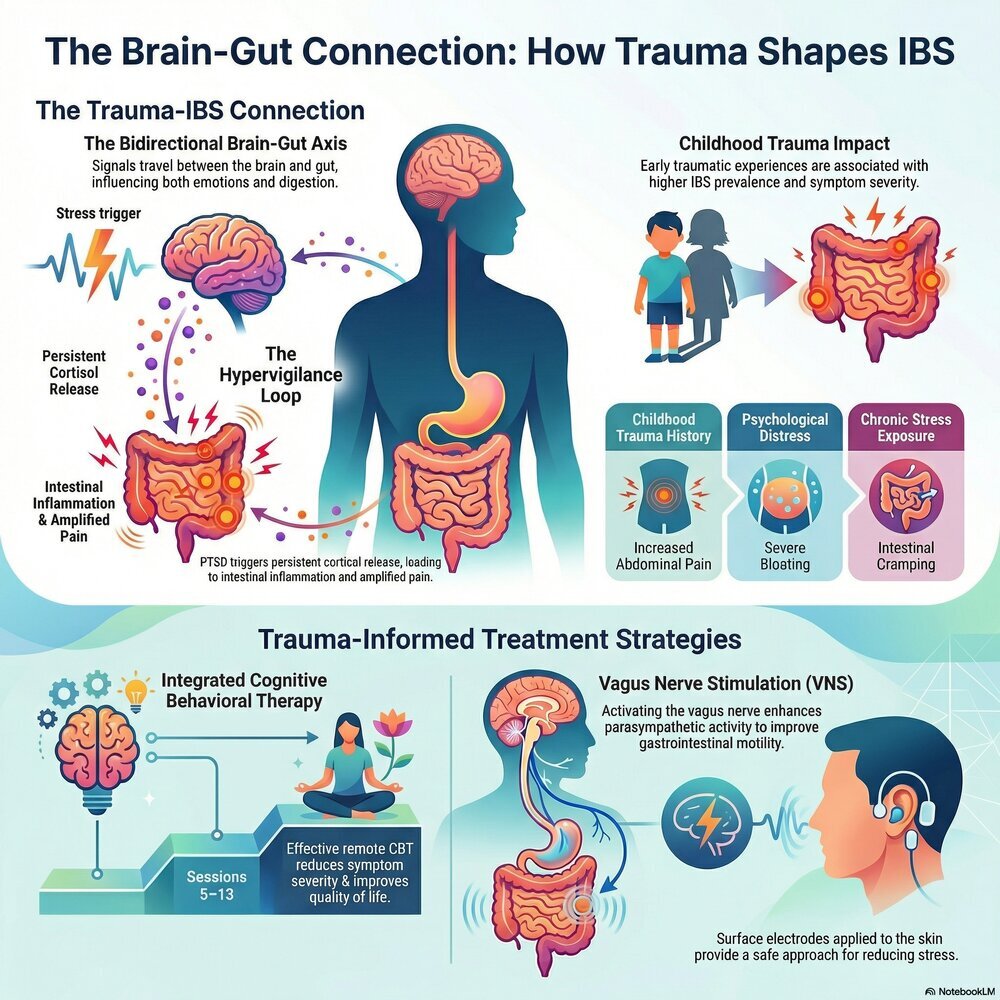
A recent study of 436 IBS patients found that patients who experienced trauma as children were more likely to experience psychological distress that manifested as physical symptoms of pain, bloating, and cramping. This research highlights manifestations of stress-induced IBS and the need for trauma-informed treatment approaches for patients with histories of chronic psychological stress and trauma.
A recent study of 436 IBS patients found that patients who experienced trauma as children were more likely to experience psychological distress that manifested as physical symptoms of pain, bloating, and cramping. This research highlights manifestations of stress-induced IBS and the need for trauma-informed treatment approaches for patients with histories of chronic psychological stress and trauma.
The Gut-Brain Axis: The Science of the Trauma-IBS Connection
The brain-gut axis refers to the bidirectional communication between the nervous and gastrointestinal systems. The gut has its own network of neurons, often called the "little brain," which controls digestion and immune responses. Stress activates the body's stress response system, which can directly affect the gut by increasing inflammation and disrupting normal functions like digestion and gut barrier protection.
Chronic stress alters intestinal sensitivity, motility, and permeability, contributing to conditions such as IBS. In turn, signals from the gut influence the brain, affecting behavior and emotions. This two-way interaction explains why stress and psychological states can worsen digestive conditions and lead to physical symptoms such as pain, bloating, diarrhea, and cramping.
Chronic stress alters intestinal sensitivity, motility, and permeability, contributing to conditions such as IBS. In turn, signals from the gut influence the brain, affecting behavior and emotions. This two-way interaction explains why stress and psychological states can worsen digestive conditions and lead to physical symptoms such as pain, bloating, diarrhea, and cramping.
PTSD and GI Symptoms: Why the Body "Keeps the Score"
PTSD is strongly linked with increased IBS symptoms such as abdominal pain, bloating, and altered bowel function. People with PTSD often experience intrusive memories, hyperarousal, changes in cognition and mood, and hypervigilance, which means being in a constant state of alertness and readiness for perceived threats.
Hypervigilance enhances the perception of bodily sensations as more painful and distressing than they are in reality. With hypervigilance elevating baseline stress levels, the hypothalamic-pituitary-adrenal (HPA) axis is activated, leading to persistent cortisol release and increased gut motility, visceral hypersensitivity, and intestinal inflammation, resulting in amplified pain, bloating, and cramping. This interplay between emotion regulation and physiological responses in the gastrointestinal tract explains why IBS is common in individuals with PTSD and how symptoms often flare during periods of high stress.
Hypervigilance enhances the perception of bodily sensations as more painful and distressing than they are in reality. With hypervigilance elevating baseline stress levels, the hypothalamic-pituitary-adrenal (HPA) axis is activated, leading to persistent cortisol release and increased gut motility, visceral hypersensitivity, and intestinal inflammation, resulting in amplified pain, bloating, and cramping. This interplay between emotion regulation and physiological responses in the gastrointestinal tract explains why IBS is common in individuals with PTSD and how symptoms often flare during periods of high stress.
A Holistic Path to Healing: Trauma-Informed Care for IBS
Beyond Diet: Integrating Stress Management into GI treatment
In clinical studies, internet-delivered cognitive behavioral therapies, including exposure-based cognitive behavioral therapy, cognitive behavioral therapy for self-management, and cognitive behavioral therapy for stress management, administered in 5 to 13 sessions over 5 to 10 weeks, have been shown to be a cost-effective method in reducing symptom severity and quality of life for IBS patients.
With increasing internet use and the growth of remote health care, there is a need for internet-delivered mental health interventions to be integrated into comprehensive IBS treatment, as psychological treatment effectively improves quality of life and patient outcomes. However, more carefully planned and executed randomized clinical trials of commonly used IBS treatments are required to establish long-term efficacy and safety profiles.
With increasing internet use and the growth of remote health care, there is a need for internet-delivered mental health interventions to be integrated into comprehensive IBS treatment, as psychological treatment effectively improves quality of life and patient outcomes. However, more carefully planned and executed randomized clinical trials of commonly used IBS treatments are required to establish long-term efficacy and safety profiles.
Vagus Nerve Stimulation: Techniques to Calm the Nervous System
The vagus nerve is a long cranial nerve that serves as a bidirectional pathway between the brain and the gut, influencing heart rate, digestion, and inflammatory mechanisms. Vagus Nerve Stimulation (VNS) is a therapeutic intervention that activates the vagus nerve and modulates the hypothalamic-pituitary-adrenal (HPA) axis, an important pathway in the body’s stress response.
VNS—both invasive (implantable devices delivering electrical impulses to the vagus nerve) and noninvasive (surface electrodes applied to the skin)—modulates stress-response systems and enhances parasympathetic nervous system activity, thereby improving gastrointestinal motility and demonstrating symptom relief in individuals with IBS. Evidence suggests that noninvasive VNS is a safe and effective approach for reducing stress and improving symptoms across a wide spectrum of gastrointestinal conditions, including IBS.
VNS—both invasive (implantable devices delivering electrical impulses to the vagus nerve) and noninvasive (surface electrodes applied to the skin)—modulates stress-response systems and enhances parasympathetic nervous system activity, thereby improving gastrointestinal motility and demonstrating symptom relief in individuals with IBS. Evidence suggests that noninvasive VNS is a safe and effective approach for reducing stress and improving symptoms across a wide spectrum of gastrointestinal conditions, including IBS.
FAQs
Can stress or trauma really cause IBS symptoms to worsen?
Yes. Chronic stress and trauma can significantly affect the brain-gut axis, the communication network between the brain and digestive system. Research suggests that ongoing stress may increase gut sensitivity, alter bowel function, and contribute to symptoms such as abdominal pain, bloating, cramping, diarrhea, and constipation in individuals with IBS.
Why is IBS more common in people with PTSD?
PTSD is associated with heightened stress responses, increased cortisol production, and hypervigilance, which can make normal digestive sensations feel more intense or painful. These changes can affect gut motility, inflammation, and nervous system signaling, helping explain why IBS symptoms are often more severe or frequent in individuals living with PTSD.
Can treating stress improve IBS symptoms?
For many people, yes. Studies have shown that therapies such as cognitive behavioral therapy (CBT), mindfulness practices, relaxation techniques, and other stress-management approaches may help reduce the severity of IBS symptoms and improve quality of life. Because IBS involves both the gut and the nervous system, addressing emotional health can be an important part of treatment.
What is the vagus nerve, and how does it affect IBS?
The vagus nerve is a major communication pathway between the brain and the digestive tract. It helps regulate digestion, inflammation, and the body's stress response. Techniques that support vagal activity—such as deep breathing exercises, meditation, yoga, and certain forms of vagus nerve stimulation—may help calm the nervous system and improve IBS symptoms in some individuals.
Is IBS "all in your head" if stress makes symptoms worse?
No. IBS is a real medical condition involving complex interactions among the digestive, nervous, and immune systems, as well as the gut microbiome. While stress and trauma can influence symptoms, IBS is not imaginary or purely psychological. Understanding the brain-gut connection helps explain why both physical and emotional factors play a role in symptom development and management.
References
1Qin, H. Y., Cheng, C. W., Tang, X. D., & Bian, Z. X. (2014). Impact of psychological stress on irritable bowel syndrome. World journal of gastroenterology, 20(39), 14126–14131. https://doi.org/10.3748/wjg.v20.i39.14126
2Cohen, S., Murphy, M. L. M., & Prather, A. A. (2019). Ten Surprising Facts About Stressful Life Events and Disease Risk. Annual review of psychology, 70, 577–597. https://doi.org/10.1146/annurev-psych-010418-102857
3Chang L. (2011). The role of stress on physiologic responses and clinical symptoms in irritable bowel syndrome. Gastroenterology, 140(3), 761–765. https://doi.org/10.1053/j.gastro.2011.01.032
4Pitman, R. K., Rasmusson, A. M., Koenen, K. C., Shin, L. M., Orr, S. P., Gilbertson, M. W., Milad, M. R., & Liberzon, I. (2012). Biological studies of post-traumatic stress disorder. Nature reviews. Neuroscience, 13(11), 769–787. https://doi.org/10.1038/nrn3339
5Margolis, K. G., Cryan, J. F., & Mayer, E. A. (2021). The Microbiota-Gut-Brain Axis: From Motility to Mood. Gastroenterology, 160(5), 1486–1501. https://doi.org/10.1053/j.gastro.2020.10.066
6Dong, Z., Wang, X., Xuan, L., Wang, J., Zhan, T., Chen, Y., Xu, S., & Ji, D. (2025). The interaction effect between childhood trauma and negative events during adulthood on development and severity of irritable bowel syndrome. BMC gastroenterology, 25(1), 321. https://doi.org/10.1186/s12876-025-03919-7
7Schubach, A., Quigley, B. M., Lackner, J. M., & Gudleski, G. D. (2024). Somatization Mediates the Relationship Between Childhood Trauma and Pain Ratings in Patients with Irritable Bowel Syndrome. Journal of clinical gastroenterology, 58(10), 1034–1042. https://doi.org/10.1097/MCG.0000000000001974
8Lakhan, S. E., & Kirchgessner, A. (2010). Neuroinflammation in inflammatory bowel disease. Journal of neuroinflammation, 7, 37. https://doi.org/10.1186/1742-2094-7-37
9Pacheco, R. L., Roizenblatt, A., Góis, A. F. T., Latorraca, C. O. C., Mota, C. F. M. G. P., & Riera, R. (2019). What do Cochrane systematic reviews say about the management of irritable bowel syndrome?. Sao Paulo medical journal = Revista paulista de medicina, 137(1), 82–91. https://doi.org/10.1590/1516-3180.2018.053740119
10Larauche, M., Mulak, A., & Taché, Y. (2012). Stress and visceral pain: from animal models to clinical therapies. Experimental neurology, 233(1), 49–67. https://doi.org/10.1016/j.expneurol.2011.04.020
11Kim, H., Oh, Y., & Chang, S. J. (2022). Internet-Delivered Cognitive Behavioral Therapy in Patients With Irritable Bowel Syndrome: Systematic Review and Meta-Analysis. Journal of medical Internet research, 24(6), e35260. https://doi.org/10.2196/35260
12Veldman, F., Hawinkels, K., & Keszthelyi, D. (2025). Efficacy of vagus nerve stimulation in gastrointestinal disorders: a systematic review. Gastroenterology report, 13, goaf009. https://doi.org/10.1093/gastro/goaf009
















 Recipes
 Products

Comments
Join The Conversation...