


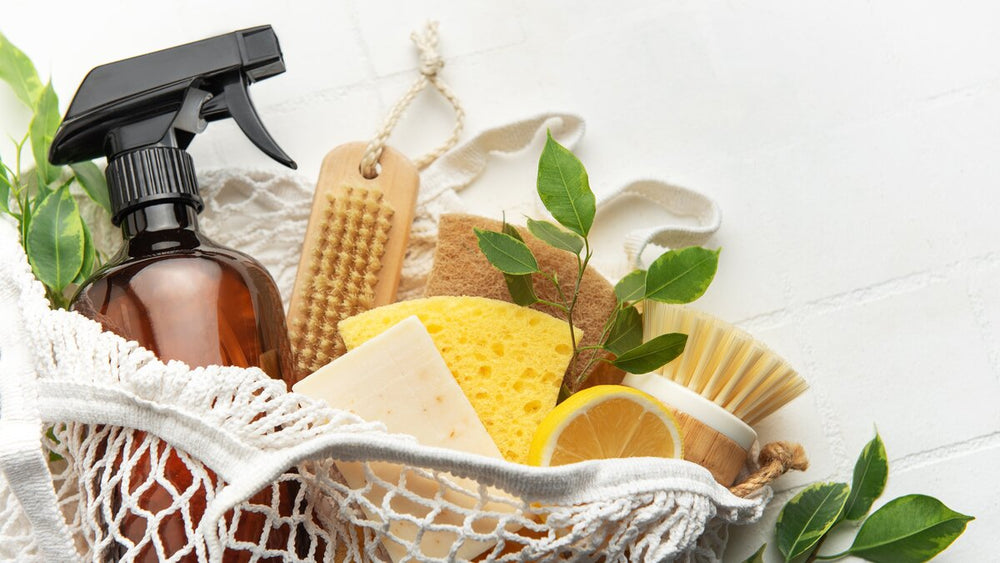
Natural Cleaning: A Greener and Healthier Home
Dig out those dust pans! Find your favorite mop! Brush up on your brooming! Spring cleaning season is here, and Foodguides is ready to help. If you plan to clean, why not make it green?
Keep reading Foodguides fam for tips and tricks to keeping a green (and clean!) home.
Why Choose Natural Cleaning? Health and Environmental Benefits
Cleaning is a tiresome but necessary chore to achieve optimal health. Over time, dust, allergens, viruses, bacteria, and other contaminants build up in your home and can cause numerous health issues. It’s important to choose green products that not only clean effectively, but are healthy for your body and home.
Reducing Exposure to Harsh Chemicals and Toxins (e.g., VOCs, Ammonia)
Common cleaning products are filled with potentially harmful chemicals. A study in the International Journal of Occupational and Environmental Health found more than 132 chemical mixtures in 105 products! These mixtures included surfactants, solvents, glycol ethers, fragrances, acids, bases, pH-stabilizers, phosphates, and salts.
Cleaning products also have Volatile Organic Compounds (VOCs), which are released as gases that can be harmful if inhaled or ingested. VOCs can be classified into three groups: (1) very volatile organic compounds (VVOCs), (2) VOCs, and (3) semi-volatile organic compounds (SVOCs).
While not technically a VOC (because it is composed of nitrogen and hydrogen rather than carbon), ammonia is another dangerous gas found in common cleaning products, especially glass cleaners. Exposure to ammonia can lead to abdominal pain, burning sensations in the nose, throat, lungs, and eyes, coughing, and skin blisters.
By choosing green products, you will reduce your exposure to harmful VOCs and promote a healthier lifestyle.
Green Guidance #1 - VOCs are categorized by boiling point. The lower the boiling point, the higher the volatility.
Lowering Your Environmental Footprint and Water Pollution
What happens when you’ve finished using your cleaning product? Do you throw the bottle away? Did you check if the bottle was completely empty?
Unused household cleaners are classified as Household Hazardous Waste (HHW). If improperly disposed of, these toxins can contaminate groundwater and cause serious environmental damage. If you need to dispose of your cleaning supplies, locate the nearest HHW collection center and drop them off for proper disposal.
You can also choose to use greener alternatives to traditional cleaners. See below:
Instead of toilet cleaners -> try a mixture of mild detergent and bleach
Instead of furniture polish -> try lemon oil and mineral water
Instead of spot removers -> try a mixture of cold water and detergent
Green Guidance #2 - The average U.S. household creates 30 pounds of HHW per year!
Cost-Effectiveness: Making Cleaners with Simple Household Staples
You don’t have to venture into a faraway land for ingredients to create household cleaners. Most of the time, they’ve already made themselves at home in your pantry. By creating your own cleaning solutions, you’re saving money that would otherwise be spent on expensive cleaning products.
Green Guidance #3 - Some companies label their cleaning products as “green” but make only generic claims, such as “eco-friendly” or “environmentally safe”. This is called greenwashing. If you’d like to know if your product is truly green, look for the Safer Choice and DfE labels, which are managed by the Environmental Protection Agency (EPA).
The Core Ingredients of Natural Cleaning
Natural cleaning products are usually composed of a mixture of three ingredients: vinegar, baking soda, and essential oils.
Vinegar: The Multi-Purpose Acidic Cleaner and Disinfectant
Vinegar is an excellent cleaner due to its acidic and consequent disinfectant qualities. Vinegar is created through fermentation, specifically when a carbohydrate is fed to yeast cells, which convert it into carbon dioxide and alcohol. The resulting mixture is fermented again (with bacteria rather than yeast) after exposure to oxygen. The final substance, vinegar, has a pH of 2.2-3.0, which helps break down tough substances and may help reduce the growth of some microorganisms on household surfaces.
Baking Soda (Bicarbonate of Soda): The Gentle Scourer and Odor Absorber
Baking soda is at the other end of the pH scale and is classified as a base. It can remove hydrogen atoms from other materials, making it a gentle scourer. Baking soda can also absorb odors, making it a simpler (and cheaper!) alternative to air fresheners.
Essential Oils: Natural Scenting and Antimicrobial Properties (e.g., Tea Tree, Lemon)
Essential oils are known for their unique scents and numerous fragrance combinations, making them an excellent natural choice for your home compared to synthetically derived air fresheners and perfumes. Some essential oils also have antimicrobial properties. These include tea tree, lemon, thyme, lavender, peppermint, cinnamon, cajuput, eucalyptus, clove, and sage.
Green Guidance #4 - If you choose to create your own household cleaners, be sure to do your research! Your goal is to create a cleaner that is safe and effective. If you experience any adverse effects (burning in the nose, eyes, chest, etc.), stop use immediately and consult your doctor.
DIY Recipes for a Non-Toxic Home
Here are some of our favorite green cleaner recipes you can make at home!
All-Purpose Spray: Combining Vinegar and Water for Surfaces
Ingredients: 1 cup of white vinegar, 1 cup of water, 15-20 drops of preferred essential oil blend
Directions: Mix vinegar, water, and essential oils together. Place in a spray bottle.
Recommended Use: Kitchen/bathroom counters, sinks, bathtubs, toilets, doorknobs, toys, and lightswitches
Scrub Paste: Creating a Powerful Cleaner with Baking Soda
Ingredients: 2 tablespoons of baking soda and 1 quart of warm water
Directions: Mix baking soda and water together to make a paste. If the mixture is too watery, add more baking soda.
Recommended Use: Stainless steel surfaces and refrigerator interior
Glass and Mirror Cleaner: Achieving Streak-Free Shine
Ingredients: 3 tablespoons of vinegar, 2 cups of water, and ¼ to ½ teaspoons of liquid detergent
Directions: Mix vinegar, water, and liquid detergent in a spray bottle. Shake well before spraying onto windows.
Recommended Use: Glass, windows, and mirrors
Green Guidance #5 - Use a microfiber towel or an old newspaper when using household cleaners to keep the entire cleaning process eco-friendly!
Safety and Best Practices for Natural Cleaners
Natural cleaners are an excellent addition to any home, but may not be appropriate for all surfaces. They should also be stored appropriately.
Surfaces to Avoid (e.g., Marble, Granite) with Acidic Cleaners
Natural cleaners with acidic properties (ex. vinegar) should never be used on granite, limestone, or marble countertops, electronic screens, dishwashers, kitchen knives, hardwood floors, washing machines, stainless steel, or rubber gaskets. The acids found in vinegar can damage these surfaces, affecting their durability and aesthetic qualities.
Green Guidance #6 - Vinegar is an excellent window cleaner! Try creating your own vinegar-based natural cleaner for a streak-free shine.
Proper Storage and Labeling of Homemade Solutions
After you’ve created your homemade natural cleaning solution, be sure to store and label it properly to ensure safe future use. You’ll want to avoid any potential harmful contaminants while maintaining the cleaner’s antimicrobial integrity. Place household cleaners in a sealed container/bottle in a cool, dry area. Don’t forget to include the expiration date - most disinfectants are good for up to two years.
Green Guidance #7 - Little hands are always busy! While these cleaning products are remarkably safer for your home, keep them away from children and pets.
Will you be creating your own green products? Share your recipes in our comments section below, and be sure to tag us on social media!
FAQs
Are natural cleaning products as effective as conventional cleaners?
Natural cleaning products can be effective for many household cleaning tasks, including removing dirt, grease, and odors. However, some situations—such as disinfecting surfaces after exposure to certain pathogens—may require the use of EPA-registered disinfectants.
Is vinegar a disinfectant?
Vinegar has antimicrobial properties and can help reduce some microorganisms on surfaces. However, it is not considered a registered disinfectant and should not be relied upon in situations requiring medical-grade disinfection.
How does using natural cleaners support a healthier home environment?
Natural cleaning products may help reduce exposure to certain chemicals, fragrances, and volatile organic compounds (VOCs), which can contribute to indoor air quality concerns for some individuals.
Can I mix vinegar and baking soda together?
Yes, but the reaction is short-lived. When mixed, vinegar and baking soda react to form water, carbon dioxide, and a salt. While the bubbling action can help loosen debris, each ingredient's cleaning power is reduced once the reaction is complete.
How does this relate to overall wellness?
Indoor environmental quality plays a role in overall health. Reducing unnecessary exposure to irritants, maintaining clean living spaces, and improving indoor air quality can support respiratory comfort and general well-being.
Are essential oils safe to use in homemade cleaners?
Many essential oils are commonly used in homemade cleaning products, but they should be used carefully. Some oils may irritate the skin or respiratory tract, and certain oils can be toxic to pets. Always follow safety recommendations and proper dilution guidelines.
References
1EPA. (2026). What are volatile organic compounds?, United States Environmental Protection Agency, https://www.epa.gov/indoor-air-quality-iaq/what-are-volatile-organic-compounds-vocs
2EPA. (2026). Identifying greener cleaning products, United States Environmental Protection Agency, https://www.epa.gov/greenerproducts/identifying-greener-cleaning-products
3Gerster, F., Vernez, D., Wild, P., and Hopf, N. (2014). Hazardous substances in frequently used professional cleaning products, International Journal of Occupational and Environmental Health, https://pmc.ncbi.nlm.nih.gov/articles/PMC4096065/
4Chemical Safety Facts. (2023). Ammonia, Information on Chemicals in Everyday Products, https://www.chemicalsafetyfacts.org/chemicals/ammonia/
5NCDEQ. (2026). Household hazardous waste, North Carolina Department of Environmental Quality, https://www.deq.nc.gov/about/divisions/waste-management/solid-waste-section/special-wastes-and-alternative-handling/household-hazardous-waste
7BBC Future Staff. (2023). Why is vinegar so good at cleaning?, BBC, https://www.bbc.com/future/article/20230303-why-vinegar-is-so-good-at-cleaning
8Welin, M. (2024). Is cleaning with baking soda better for the environment?, BBC, https://www.bbc.com/future/article/20241010-does-cleaning-baking-soda-really-work
9Winska, K., Macza, W., Lyczko, J., Grabarczyk, M., Czubaszek, A., and Szummy, A. (2019). Essential oils as antimicrobial agents - Myth or real alternative?, Molecules, https://pmc.ncbi.nlm.nih.gov/articles/PMC6612361/#sec1-molecules-24-02130
10Santanachote, P., and Yao, D. (2025). 9 things you should never clean with vinegar, Consumer Reports, https://www.consumerreports.org/home-garden/cleaning/things-you-should-never-clean-with-vinegar-distilled-white-vinegar-a3336471803/
11Residential Cleaning. (2025). How to safely store cleaning chemicals in your home, Brevard Home Cleaning, https://brevardhomecleaning.com/storing-cleaning-chemicals/
12Leverette, M., Picott, K., and Estep, E. (2022). 6 smart and safe ways to store your cleaning supplies, The Spruce, https://www.thespruce.com/smarter-safer-cleaning-supply-storage-ideas-5190439














 Recipes
 Products

Comments
Join The Conversation...