



Mobility Tools Explained: PNF Stretching, Resistance Bands, and When to Use Them
Resistance Bands and Mobility Straps: Deepening Stretches and Increasing Range of Motion
Assisted stretches are traditionally done with a partner. They allow you to make use of a technique called proprioceptive neuromuscular facilitation – or PNF. PNF stretches are performed by having your partner passively move your limb into a stretch to the point of mild discomfort. Your partner then stabilizes the limb while you contract your muscles statically as hard as you can for 6 seconds (this is enough time for anyone to reach peak muscle tension). Then you relax, and you will find that your partner can easily move your limb a few degrees further into a deeper stretch.
The mechanism by which PNF stretching is effective is mediated by a sensory receptor called the Golgi tendon organ. Golgi tendon organs sense the buildup of tension in a tendon and respond by reflexively relaxing the affected muscle. Evidence shows that PNF stretching works just as effectively as static stretching for increasing the range of motion.
You can accomplish PNF stretching on your own with a mobility strap. These simple, but useful devices allow you to place one appendage into a loop on the strap, relax the muscles around that appendage, and then use your non-looped arm(s) to passively stretch, and then hold the limb for a good solo PNF stretch. Like static stretching, PNF stretching is most effective when performed as a post-workout cooldown, as pre-exercise PNF may transiently impair maximal strength and power performance.
A good example of performing Self-PNF with a mobility strap is the self-PNF hamstring stretch illustrated here: 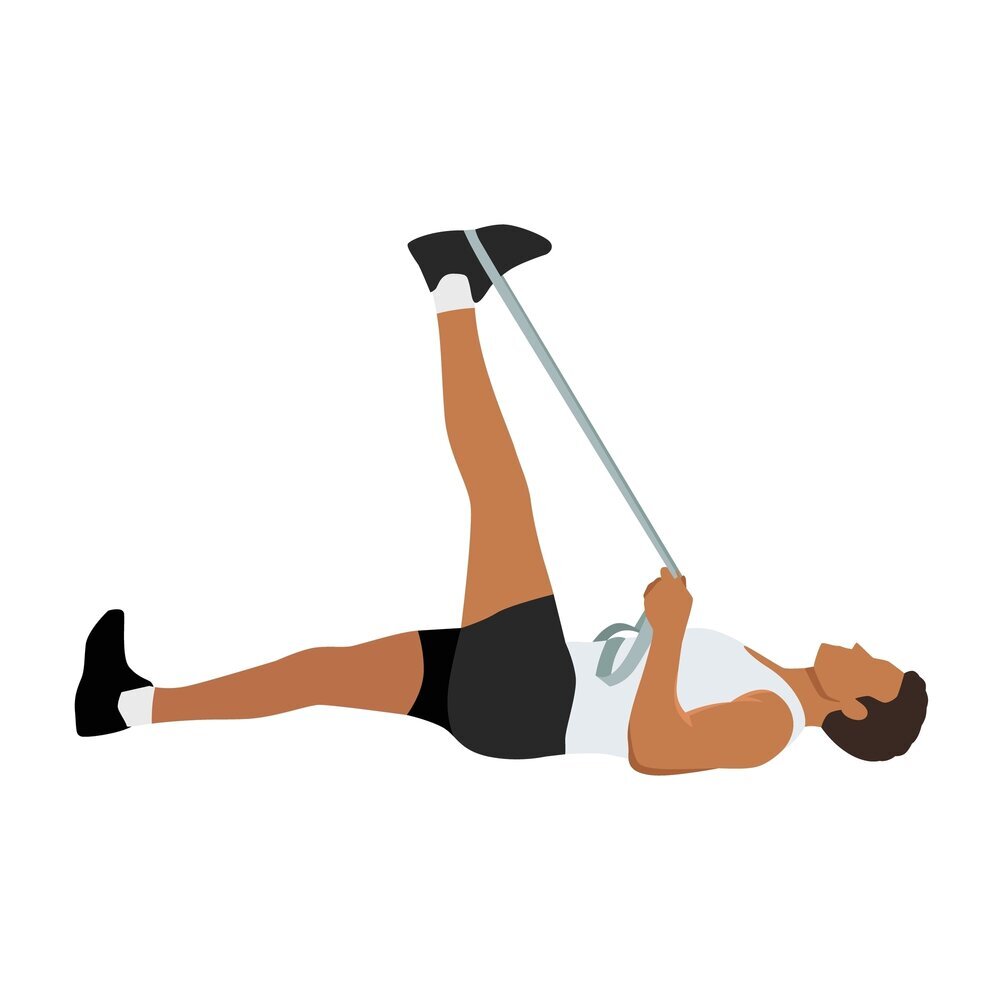 Active stretches, in which you apply muscular effort to move directly, can be enhanced with resistance bands. This technique, popularized by physical therapist Kelly Starrett, works by pulling joints (usually hip or ankle) into a specific, often lateral or posterior direction while the user moves through a range of motion. The bands improve joint gliding, enabling smooth movement through a full range of motion.
Active stretches, in which you apply muscular effort to move directly, can be enhanced with resistance bands. This technique, popularized by physical therapist Kelly Starrett, works by pulling joints (usually hip or ankle) into a specific, often lateral or posterior direction while the user moves through a range of motion. The bands improve joint gliding, enabling smooth movement through a full range of motion.Resistance bands are best used as a pre-workout tool to prepare the body for more efficient movements. Here is a good example of using resistance bands for greater mobility in this hip-opening routine.
Integrating Mobility Tools into Your Routine
Do you need mobility tools to improve the range of motion? Probably not! Research on whether mobility tools improve outcomes is mixed. For example, instrument-assisted soft-tissue mobilization, which is an aggressive myofascial release technique administered by physical therapists, has been shown to only increase range of motion similar to levels that can be achieved with active self-stretching in the calf muscles, and is graded with (only) a “B”-level for effectiveness in increasing shoulder range of motion, so there is no clear evidence that mobility tools are a must-have to improve range of motion beyond what you can achieve with simple, bodyweight-only exercises.
While not necessary, mobility tools are best viewed as ways to make stretching sessions more engaging. This makes adherence to a routine more likely, the best guarantor of successful outcomes!
FAQs
What's the difference between PNF stretching and regular static stretching?
Static stretching involves holding a muscle in a lengthened position for a period of time, while proprioceptive neuromuscular facilitation (PNF) stretching combines a stretch with a brief muscle contraction before deepening the stretch. Both techniques can improve flexibility and range of motion, but PNF may help some individuals achieve greater short-term gains in mobility.
Should I use resistance bands before or after a workout?
Resistance bands are often most effective before exercise as part of a dynamic warm-up. They can help improve joint mobility, activate key muscle groups, and prepare the body for movement. In contrast, static stretching and PNF stretching are generally better suited for post-workout recovery sessions.
Do I need special mobility tools to improve flexibility and mobility?
Not necessarily. Many mobility improvements can be achieved using bodyweight exercises and simple stretching routines. Mobility tools such as resistance bands, foam rollers, and mobility straps can make sessions more engaging and help target specific areas, but consistency is more important than the equipment itself.
Can mobility training help reduce aches and pains from sitting all day?
Yes. Prolonged sitting can contribute to tight hip flexors, reduced spinal mobility, and muscle stiffness. Incorporating regular mobility exercises, stretching, and movement breaks throughout the day may help improve range of motion, reduce discomfort, and support better posture.
How often should I perform mobility exercises?
For most people, 5–10 minutes of mobility work performed several days per week can be beneficial. Individuals with specific mobility restrictions or athletic goals may benefit from daily practice. Consistency over time is typically more important than the length of any single session.
References
1Lempke, L., Wilkinson, R., Murray, C., & Stanek, J. (2018). The Effectiveness of PNF Versus Static Stretching on Increasing Hip-Flexion Range of Motion. Journal of sport rehabilitation, 27(3), 289–294. https://doi.org/10.1123/jsr.2016-0098
2Squat University. (2021, November 3). 5 Minute Hip Mobility Routine (THIS WORKS!). YouTube. https://youtu.be/O3dzeagyhH8?si=-0HDNs0BYEwbieZG
3Myburgh, C., Hammern, A., Mannfjord, P., & Boyle, E. (2018). Effects of Instrument-Assisted Soft-Tissue Mobilization on Ankle Range of Motion and Triceps Surae Pressure Pain Sensitivity. Journal of rehabilitation medicine. Clinical communications, 1, 1000005. https://doi.org/10.2340/20030711-1000005
4Hussey, M. J., Boron-Magulick, A. E., Valovich McLeod, T. C., & Welch Bacon, C. E. (2018). The Comparison of Instrument-Assisted Soft Tissue Mobilization and Self-Stretch Measures to Increase Shoulder Range of Motion in Overhead Athletes: A Critically Appraised Topic. Journal of sport rehabilitation, 27(4), 385–389. https://doi.org/10.1123/jsr.2016-0213












 Recipes
 Products

Comments
Join The Conversation...