


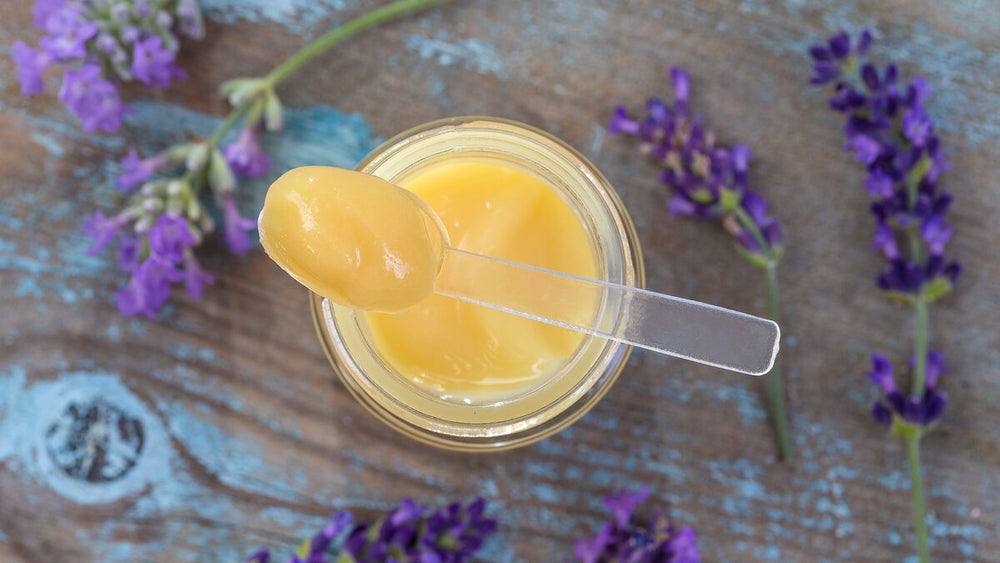
Defining Royal Jelly: The Queen Bee's Exclusive Food
Ever wonder what the matriarch of the hive prefers to nosh on? Let me introduce you to royal jelly, a milky-white substance produced by worker bees. Royal jelly is actually quite nutritionally packed, containing water, proteins, fatty acids, and simple carbohydrates. Royal jelly is not to be confused with honey or bee pollen. While honey production comes from nectar collection (and the bee’s saliva), royal honey is actually secreted from worker bees. Once created, royal jelly will feed the queen and also provide nutrients to new bee babies. Once bee larvae are ready to join the hive, they switch over to eating honey.
The queen is the only bee in the hive that will consume royal honey for her entire life. A very interesting paper noted that queen bees and worker bees are actually all genetically identical twins. Still, due to the queen bee’s diet of exclusive royal honey, queens are typically larger in size, more fertile, have better resistance to environmental stress, and live up to ten times longer compared to workers. Beekeepers find this process quite fascinating, but note that the steps required to extract royal honey are much more difficult than harvesting honey, which helps explain the higher price compared to other bee products.
Royal Jelly (not surprisingly) contains many rich nutrients.
While honey contains only simple sugars (and probiotics if you specifically consume raw honey), royal jelly has a diverse nutrition profile. In addition to proteins, fats, vitamins, and simple carbohydrates, royal jelly contains two unique compounds: 10-HDA and royalactin. 10-HDA (or 10-hydroxy-2-decenoic acid if you prefer its government name) is a fatty acid found exclusively in royal jelly (six other types of fatty acids have also been identified in royal jelly). 10-HDA can be isolated from royal jelly and incorporated into skin care products and dietary supplements. Researchers even found that 10-HDA can help regulate gene expression, thereby lowering oxidative stress (i.e., inflammation and stress in the body).
Similarly, royalactin is the major protein component of royal jelly and is exclusive to this product. In animal studies, the use of royalactin actually shortened developmental time and increased body size without any notable harmful effects. Researchers at Stanford found that royalactin prevented stem cells from differentiating, meaning it can keep them younger for longer (which can come in handy for medical procedures).
*Note: the micronutrient composition of royal jelly may vary region to region (i.e., royal jelly from Italian beehives has been found to contain higher fat content compared to French territories).
Traditional Uses and Emerging Health Claims
It may not be surprising to learn that royal honey has a place in history. The first notable use of royal honey occurred in ancient Egypt, where it was reserved for royalty and medical practitioners. While it was prized for its sweet taste, ancient civilizations also recognized the potential health benefits of royal honey. Egyptians believed royal honey possessed antibacterial and anti-inflammatory properties (and, indeed, it did) and used it frequently for burn and wound treatment. It was also often prescribed as a fix for a lingering cough and digestive problems. The Greeks and Romans also found royal honey particularly interesting, using it specifically for skin conditions.
In the current medical literature, royal jelly has been shown to offer multiple health benefits with regular use. According to the International Journal of Molecular Sciences, royal jelly contains metabolic, cardiovascular, anti-inflammatory, and antioxidant properties. The metabolic effects include potential reductions in glucose levels in diabetic models, as well as reductions in insulin resistance and the frequency of hyperglycemia. Interestingly, royal jelly has also been shown to enhance the production of anti-inflammatory cytokines, small immune-modulatory molecules that suppress inflammation. This is due to its phenolic and flavonoid content.
One additional fascinating (and incredibly useful) aspect of royal jelly is that it has been shown to reduce the growth of Gram-negative organisms, a particular type of bacteria (e.g., Staphylococcus aureus) that can be difficult to treat with antimicrobials. There are additional reports that royal jelly may enhance wound healing, exert neuroprotective effects, improve estrogenic activity (i.e., possibly reducing menopausal symptoms), and exhibit anticancer properties. These claims still require substantial research to substantiate their validity, but they are a positive finding that, if further explored, could change how we view royal jelly.
Considerations and Safe Consumption
Royal jelly sounds like a no-brainer, but it can pose significant risks to folks with severe allergies, specifically allergies to dust mites, shellfish, or cockroaches (bet you didn’t know you could be allergic to cockroaches, but you can). Reported reactions can range from mild nasal irritation to severe asthma attacks, possibly progressing to anaphylaxis. This is largely due to a specific type of antibody called IgE. IgE is the antibody that causes allergies; it's produced by the body when it thinks something harmless (e.g., pollen) is dangerous. Those with IgE hypersensitivities will likely not do well with royal jelly, as at least 18 different IgE protein components have been identified in royal jelly.
One consideration for preventing any reaction is proper storage of royal jelly. Prolonged high-temp exposure will do your royal jelly (and you) no good, forming a potentially toxic compound called 5-hydroxymethylfurfural (say that five times fast). Honey, unlike royal jelly, pretty much lasts indefinitely. Royal jelly can degrade quickly when exposed to light, air, and improper temperatures, according to the Agriculture Institute. Most sources agree that royal jelly should be stored in a dark, room-temperature pantry in an airtight container and not consumed after the expiration date.
References
1Mibelle Biochemistry Group. (2016, April 18). The power of Royalactin: Inspired by epigenetic science, Mibelle Biochemistry presents RoyalEpigen P5—a five amino acid peptide to rejuvenate the skin. https://mibellebiochemistry.com/royalepigen-p5
2Greenwood, D. (n.d.). Royal Jelly vs Honey - What’s The Difference? | BeehiveHero. Https://Beehivehero.com/. https://beehivehero.com/royal-jelly-vs-honey/
3Yuan, C.-Y., Yang, S.-Z., Gao, C.-M., Bai, T.-M., Han, T.-T., Jiang, S.-S., Liu, S.-L., Gao, K.-K., Mao, X.-Y., Jiang, H., & Li, Y. (2024). Biologically synthesized 10-Hydroxy-2-Decenoic acid activates cornified envelope formation via PPARα signaling, and regulates oxidative respiratory chain to improve mitochondrial function. Journal of Functional Foods, 122, 106505. https://doi.org/10.1016/j.jff.2024.106505
4Kamakura, M. (2011). Royalactin induces queen differentiation in honeybees. Nature, 473(7348), 478–483. https://doi.org/10.1038/nature10093
5Conger, K. (2018, December 4). Honeybee protein keeps stem cells youthful. News Center. https://med.stanford.edu/news/all-news/2018/12/honeybee-protein-keeps-stem-cells-youthful.html
6James, A. (2025, May 22). Unlocking Royal Honeys Secrets: History, Benefits, and Safety - Beekeeper Corner. Beekeeper Corner. https://beekeepercorner.com/what-is-royal-honey-benefits-and-safety/
7Oršolić, N., & Maja Jazvinšćak Jembrek. (2024). Royal Jelly: Biological Action and Health Benefits. International Journal of Molecular Sciences, 25(11), 6023–6023. https://doi.org/10.3390/ijms25116023
8Uthaibutra, V., Kaewkod, T., Prapawilai, P., Pandith, H., & Tragoolpua, Y. (2023). Inhibition of Skin Pathogenic Bacteria, Antioxidant and Anti-Inflammatory Activity of Royal Jelly from Northern Thailand. Molecules, 28(3), 996. https://doi.org/10.3390/molecules28030996
9Leung, R., Ho, A., Chan, J., Choy, D., & Lai, C. K. (1997). Royal jelly consumption and hypersensitivity in the community. Clinical and experimental allergy : journal of the British Society for Allergy and Clinical Immunology, 27(3), 333–336.
10Best Practices for Storing Royal Jelly - Agriculture Notes by Agriculture.Institute. (2023, December 6). Agriculture Institute. https://agriculture.institute/hive-products-beekeeping-economics/best-practices-storing-royal-jelly/














 Recipes
 Products
Comments
Join The Conversation...