



When you have IBS, food often gets all the attention. What did you eat? Was it dairy? Gluten? Garlic? That suspicious salad dressing?
Diet absolutely matters for many people with IBS. But your digestive system does not operate independently from the rest of you. Your gut and nervous system are in constant communication, which means effective IBS relief sometimes requires looking beyond the plate.
That is where mind-body therapies come in. And no, this does not mean your symptoms are imaginary, psychological, or somehow your fault. IBS involves a complex relationship between the digestive system and the nervous system. The goal is not to think your way out of IBS. It is to work with a system that was already connected in the first place.
Why the Gut-Brain Connection Matters in IBS
IBS is considered a disorder of gut-brain interaction, meaning symptoms can involve changes in how the digestive tract and nervous system communicate and process information.
In plain English: the gut sends information to the brain, the brain responds, and the gut responds to the response. Very efficient. Occasionally exhausting.
Stress does not cause IBS. However, stress and anxiety can influence digestive function, pain perception, symptom awareness, and flare-ups. At the same time, unpredictable IBS symptoms can create anxiety and hypervigilance around eating, travel, work, bathrooms, and social situations.
That can create a feedback loop:
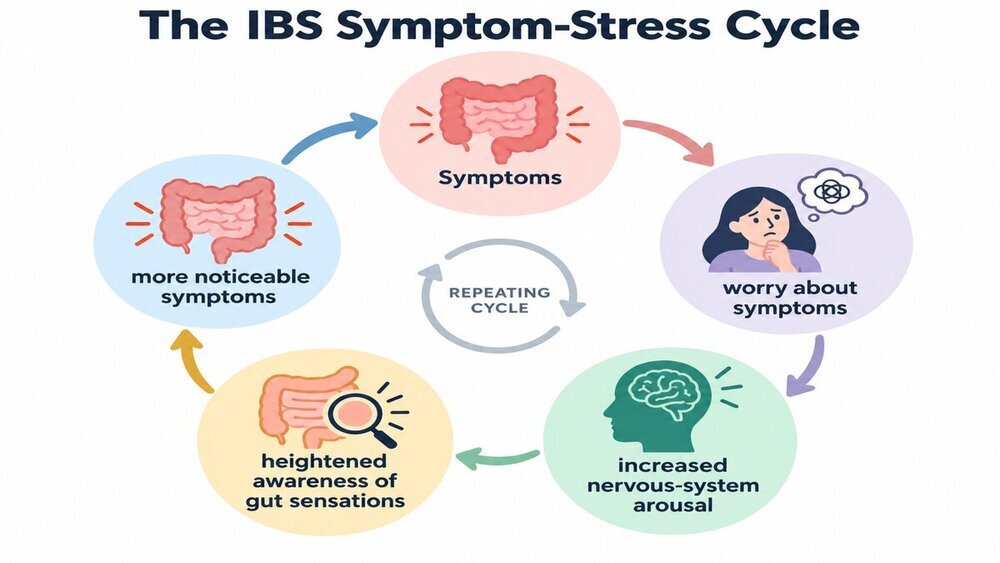
Symptoms → worry about symptoms → increased nervous-system arousal → heightened awareness of gut sensations → more noticeable symptoms.
Breaking into that loop from either direction can help. That is one reason behavioral and psychological therapies are recognized among legitimate IBS treatment options by the National Institute of Diabetes and Digestive and Kidney Diseases.
Strategy #1: Gut-Directed Hypnotherapy
Before you picture someone swinging a pocket watch and convincing you that you are a chicken, gut-directed hypnotherapy is considerably less theatrical.
It uses guided relaxation, imagery, suggestion, and focused attention specifically designed around digestive function. Sessions may include imagery involving comfortable digestion, decreased sensitivity, more regulated bowel patterns, or a calmer response to intestinal sensations.
Among mind-body approaches for IBS, gut-directed hypnotherapy has one of the stronger research histories. A 2025 systematic review and meta-analysis of gut-directed hypnotherapy found evidence that it can improve overall IBS symptoms and abdominal pain.
Traditionally, treatment has involved several sessions with a trained practitioner, although remote and digital programs are increasingly available.
To explore it:
- Look for a clinician specifically trained in gut-directed hypnotherapy rather than general hypnosis.
- Ask your gastroenterologist whether they work with a GI psychologist or behavioral health provider.
- Expect repetition. This is a skill practiced over time, not gastrointestinal sorcery performed on Tuesday at 3:00.
The aim is not to convince yourself that symptoms do not exist. It is to change how the nervous system processes and responds to gut signals.
Strategy #2: Mindfulness and Stress Reduction
Mindfulness gets tossed around so casually that it can start sounding like the solution to everything from IBS to a broken dishwasher.
For IBS, the idea is more specific.
Mindfulness teaches you to notice sensations, thoughts, and emotions without immediately reacting to them. That may be particularly useful when digestive sensations trigger a rapid cycle of monitoring, worry, muscle tension, and anticipation.
Research is promising, although mindfulness does not have exactly the same evidence base as IBS-specific CBT or gut-directed hypnotherapy. A systematic review and meta-analysis of meditation and IBS found improvements in areas including pain and IBS-related quality of life, while results for overall symptom severity were less consistent.
You also don't need a 45-minute meditation practice conducted beside a tasteful indoor fountain. Start smaller:
- Try five minutes daily. Sit comfortably and pay attention to your breathing without trying to control it.
- Use a body scan. Notice tension in your jaw, shoulders, abdomen, and pelvic floor and deliberately soften what you can.
- Pause before reacting to symptoms. Instead of immediately predicting catastrophe, notice what is actually happening right now.
- Practice when you feel well, too. Nervous-system regulation works better as a routine than as an emergency button.
For practical IBS stress management, consistency usually beats intensity. Five minutes you actually do is more useful than the elaborate 30-minute routine you avoid for six weeks.
Strategy #3: Cognitive Behavioral Therapy (CBT) and Emotional Processing Approaches
IBS-specific Cognitive Behavioral Therapy does not tell you to “think positively” until your colon gets the memo.
CBT examines the relationship between thoughts, emotions, behaviors, physical sensations, and symptoms. For someone with IBS, that might mean addressing patterns such as:
“My stomach feels strange. I'm going to have diarrhea. There won't be a bathroom. I need to cancel.”
The physical sensation may be completely real. CBT works on what happens after that sensation appears: catastrophic predictions, avoidance, constant body monitoring, or behaviors that may unintentionally reinforce fear around symptoms.
The evidence supporting CBT for IBS is substantial. In the large ACTIB randomized clinical trial, researchers studied 558 adults with persistent IBS and found that both telephone-delivered and web-based CBT produced greater improvements in IBS symptoms and daily functioning than treatment as usual.
Those improvements were not necessarily short-lived. A 24-month follow-up of ACTIB participants found that some benefits of CBT remained two years later.
Related approaches may also work with emotional awareness, acceptance, coping, or the way chronic symptoms shape behavior. The important distinction is that treatment should understand the gut-brain connection and preferably be designed for gastrointestinal disorders.
When looking for a therapist, ask specifically about experience with:
- IBS or other disorders of gut-brain interaction
- GI-focused CBT
- chronic pain or visceral sensitivity
- health anxiety or symptom-related fear
- behavioral medicine or GI psychology
This is less about putting your digestive system on a therapist's couch and more about changing patterns that can keep the gut-brain alarm system unnecessarily loud.
Putting It All Together
Mind-body therapies are not replacements for appropriate medical care, medication, or nutrition strategies. They are additional tools for digestive wellness that address a different part of IBS management.
You also don't need to do all three.
Research supports both gut-directed hypnotherapy and IBS-focused CBT, while mindfulness and meditation may offer another useful way to address stress, pain, and quality of life.
Pick one approach that feels realistic. Give it enough time to become familiar. Pay attention not only to bowel symptoms but also to pain, anxiety around symptoms, sleep, avoidance, and how much IBS interferes with ordinary life.
The goal isn't perfect control over your gut. Frankly, the gut has never signed that agreement.
The goal is a digestive system and nervous system that communicate without treating every sensation like breaking news.
I see you, and you are magical!
I see you, and you are magical!
FAQs
Can stress cause IBS?
Not by itself. IBS is a complex disorder involving interactions between the digestive tract, nervous system, and other biological and psychosocial factors. Stress can, however, influence digestive function, symptom perception, coping, and flare-ups in some people.
Does using psychological therapy mean my IBS is “all in my head”?
No. Mind-body therapies target the communication between the nervous system and digestive tract as well as the thoughts and behaviors that can develop around chronic symptoms. The NIDDK includes mental health therapies among IBS treatment approaches, alongside dietary changes, medication, and other medical management.
Which mind-body therapy has the best evidence for IBS?
Gut-directed hypnotherapy and IBS-focused CBT both have substantial clinical research supporting their use. Recent research on gut-directed hypnotherapy supports improvements in IBS symptoms and abdominal pain, while large randomized trials of CBT have demonstrated improvements in symptoms and functioning. Mindfulness-based approaches also show promise, particularly for pain and quality of life.
How quickly do mind-body strategies work?
Think in weeks rather than days. Most structured CBT, hypnotherapy, and mindfulness studies involve repeated sessions or regular practice over several weeks. These approaches are skills, and skills tend to improve with repetition.
Should I stop medication or change my diet if these strategies help?
No medication or prescribed treatment should be stopped without discussing it with your healthcare provider. Mind-body approaches generally work best as part of a broader IBS management plan rather than as a replacement for medical or nutritional care.
Persistent, severe, new, or worsening digestive symptoms should also be evaluated by a healthcare professional rather than automatically attributed to IBS.
References
1National Institute of Diabetes and Digestive and Kidney Diseases. (n.d.). Treatment for irritable bowel syndrome. U.S. Department of Health and Human Services, National Institutes of Health. https://www.niddk.nih.gov/health-information/digestive-diseases/irritable-bowel-syndrome/treatment
2Adler, E. C., Levine, E. H., Ibarra, A. N., Boparai, E. S., Hung, Y., McCrary, Q. D., & Lee, J. K. (2025). Gut‐directed hypnotherapy for irritable bowel syndrome: A systematic review and meta‐analysis. *Neurogastroenterology & Motility*. https://doi.org/10.1111/nmo.70037
3Everitt, H. A., Landau, S., O’Reilly, G., Sibelli, A., Hughes, S., Windgassen, S., Holland, R., Little, P., McCrone, P., Bishop, F., Goldsmith, K., Coleman, N., Logan, R., Chalder, T., & Moss-Morris, R. (2019). Assessing telephone-delivered cognitive–behavioural therapy (CBT) and web-delivered CBT versus treatment as usual in irritable bowel syndrome (ACTIB): A multicentre randomised trial. *Gut*. https://doi.org/10.1136/gutjnl-2018-317805
4Everitt, H. A., Landau, S., O'Reilly, G., Sibelli, A., Hughes, S., Windgassen, S., Holland, R., Little, P., McCrone, P., Bishop, F. L., Goldsmith, K., Coleman, N., Logan, R., Chalder, T., & Moss-Morris, R. (2019). Cognitive behavioural therapy for irritable bowel syndrome: 24-month follow-up of participants in the ACTIB randomised trial. *The Lancet Gastroenterology & Hepatology*. https://doi.org/10.1016/s2468-1253(19)30243-2
5Baboș, C. I., Leucuța, D. C., & Dumitrașcu, D. L. (2022). Meditation and irritable bowel syndrome, a systematic review and meta-analysis. Journal of Clinical Medicine, 11(21), 6516. https://doi.org/10.3390/jcm11216516














 Recipes
 Products


Comments
Join The Conversation...